

Bits2Field state machine
The Bits2Field state machine is one of the auxiliary state machines used specifically for parallelizing the implementation of KECCAK-F SM. Its source code is av
The Bits2Field state machine is one of the auxiliary state machines used specifically for parallelizing the implementation of KECCAK-F SM. Its source code is available here.
The Bits2Field state machine ensures correct packing of bits from different -row blocks of the Padding-KK-Bit SM into a single field element. Therefore, it operates like a (44-bits-to-1-field-element) multiplexer between the Padding-KK-Bit SM and the Keccak-F SM.
In simpler terms, it takes bits from different blocks, places them into the first 44 bit-positions of a single field element, whereupon the KECCAK-F circuit runs. The name Bits2Field state machine refers to the process of taking bits from different blocks of the Padding-KK-Bit SM and inserting them into a single field element.
Although the KECCAK-F SM is a binary circuit, instead of executing on a bit-by-bit basis, it is implemented to execute KECCAK-F operations on a 44bits-by-44bits basis. This is tantamount to running KECCAK-F hashing circuits in parallel.
The figure below depicts a simplified multiplexing process.

Mapping 44 Bits To A 64-bit Field Element
Suppose operations are carried out in a field of -bit numbers. The smallest field used in the zkProver is the Goldilocks Field where .
After multiplexing, the 44 bits are loaded into the first 44 least significant bit-positions of the field element as depicted in the figure below.
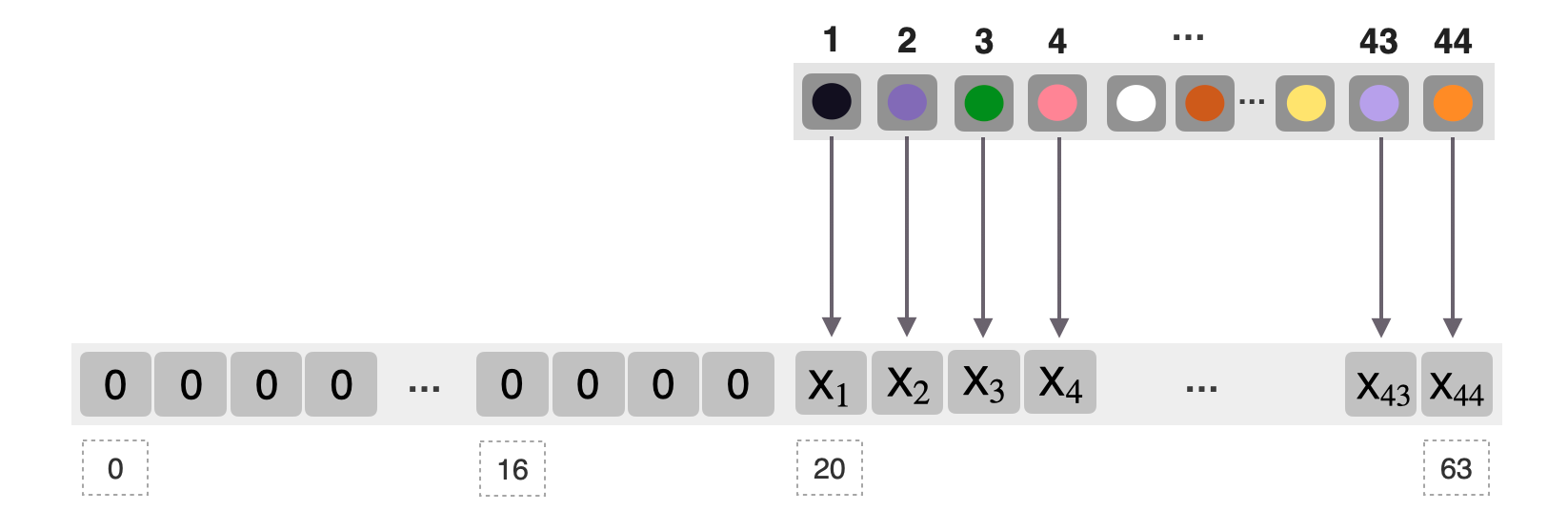
A field element as an input to the KECCAK-F circuit is of the form,
and it is composed of 20 zeroes and 44 meaningful bits related to the committed polynomials.
Given the capacity of in terms of the state machine evaluations (i.e., the degree of polynomials) and the KECCAK-F's , one obtains KECCAK-F slots.
Therefore, a total of slots blocks Keccak blocks can be processed.
This is a big improvement from the previous blocks of the 9bits-to-1field element multiplexing (i.e., ).
The Bits2Field PIL Code
The Bits2Field executor executes the multiplexing of forty-four -bit blocks into field elements, where each is a -bit field element. For reference, see the above figure where .
The question here is how to identify each of the original 9 bits of the field element to track their corresponding resultant values or values?
Note that every bit from the -th -bit block is placed at the -th position of the -bit field element.
The PIL code therefore uses factors denoted by , such that , and a after running through forty-four -bit blocks.
Suppose . Then the 44 least significant bits of the -bit field element looks like this:
The constraint checked is therefore,
The accumulated field element at the end of the execution (every forty-fourth row of the execution trace) is checked against the KECCAK-F input with the boundary constraint,
The PIL code is given below.
% "bits2field.pil"

include "keccakf.pil";

namespace Bits2Field(%N);
    pol constant FieldLatch;  // [0:44,1]
    pol constant Factor;  // 1,2,4,8,...,2**43

    pol commit bit;
    pol commit field44;

    field44' = (1-FieldLatch)*field44 + bit*Factor;
    bit *(1-bit) = 0;

FieldLatch*(field44 - KeccakF.a44) = 0;Last updated on
Padding-kk-bit state machine
The 136-byte output of the Padding-KK SM must first be translated to bits before it can be used as the Keccak-F SM's input. This is where the Padding-KK-Bit sta
Keccak-f state machine
The Keccak-F state machine is one of the secondary zkProver state machines. It computes message string hashes and validates the accuracy of those computations u