

CDKCdk erigon
cdk-erigon-sovereign
This section describes the core components and flow of the cdk-erigon configuration across its three main deployment modes: sovereign, validium, and zkRollup. These configurations vary primarily in data availability and prover setup, while sharing the same core Erigon-based client and bridge infrastructure.
cdk-erigon-sovereign
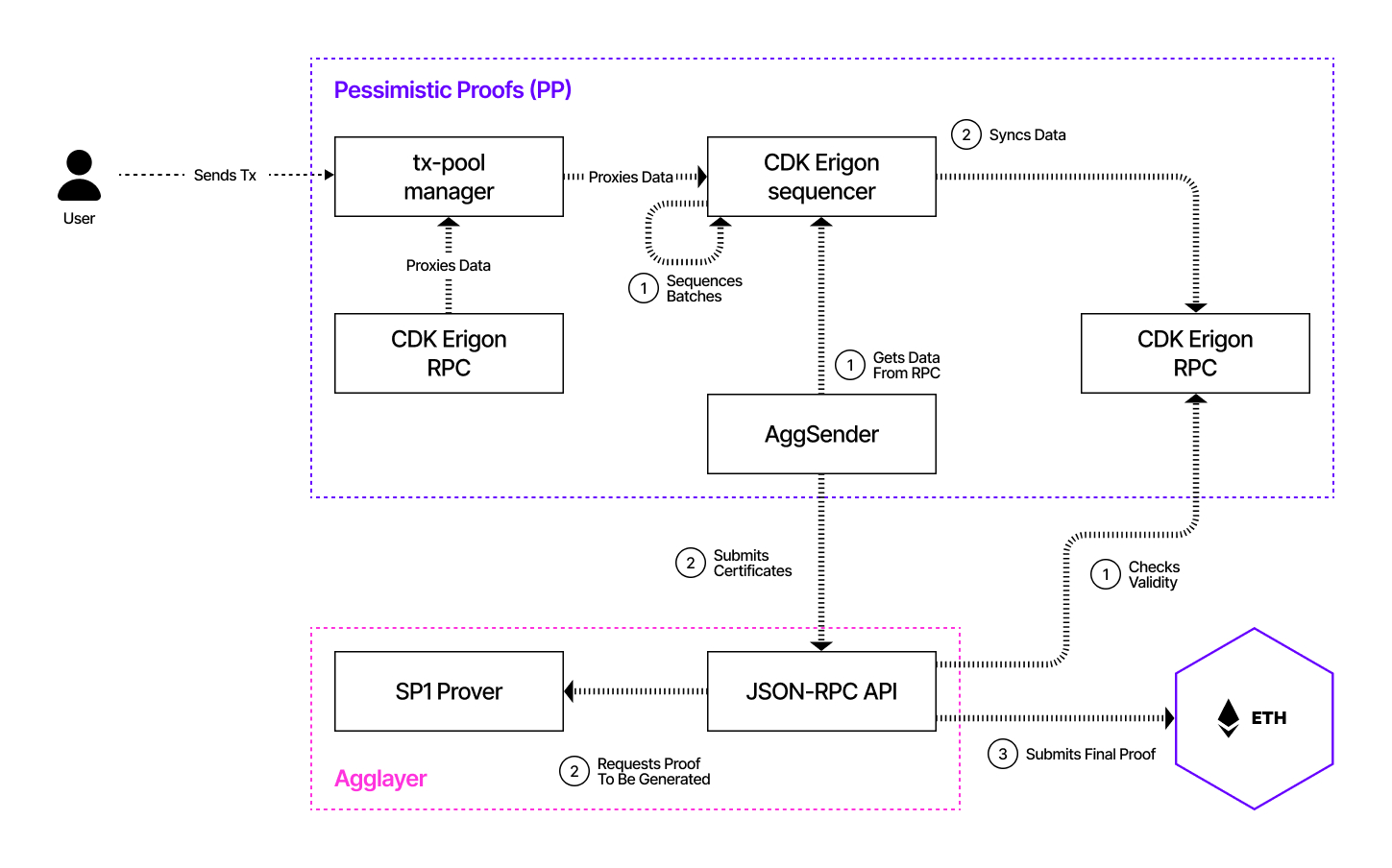
| Component | Description / Link |
|---|---|
| Execution + Consensus Layer | CDK-Erigon — Combined Ethereum client for execution and consensus |
| AggKit - Oracle | AggOracle — Updates global Ethereum Root (GER) |
| AggKit - Sender | Sends certificates to Agglayer |
| Bridge API | zkEVM Bridge Service — Enables messaging between chains |
| Ethereum Bridge Contracts | zkEVM Contracts — Settlement layer contracts on Ethereum |
| Agglayer Network | Agglayer — Aggregation layer for certificates and proofs |
| Agglayer Node — Participates in Agglayer | |
| Agglayer Prover — Generates validity proofs |
cdk-erigon-zkrollup

| Component | Description / Link |
|---|---|
| Execution + Consensus Layer | CDK-Erigon |
| Internal CDK Infrastructure | Sequence Sender and Aggregator |
| Bridge API | zkEVM Bridge Service |
| Ethereum Bridge Contracts | zkEVM Contracts |
| Data Availability Layer | On-chain data submitted directly to Ethereum (no off-chain DAC) |
| Agglayer Network | Agglayer, Agglayer Node |
| Prover Network | Hermez Prover — zk-SNARK based proof generator |
cdk-erigon-validium
💡 Note: This mode shares the same architecture as
zkrollup, but uses an alternative data availability (DA) layer.
| Component | Description / Link |
|---|---|
| Execution + Consensus Layer | CDK-Erigon |
| Internal CDK Infrastructure | Sequence Sender and Aggregator — build and send transaction batches |
| Bridge API | zkEVM Bridge Service |
| Ethereum Bridge Contracts | zkEVM Contracts |
| Data Availability Layer | Custom DAC — Off-chain data availability committee |
| Agglayer Network | Agglayer, Agglayer Node |
| Prover Network | Hermez Prover — zk-SNARK based proof generator |
User Data Flow
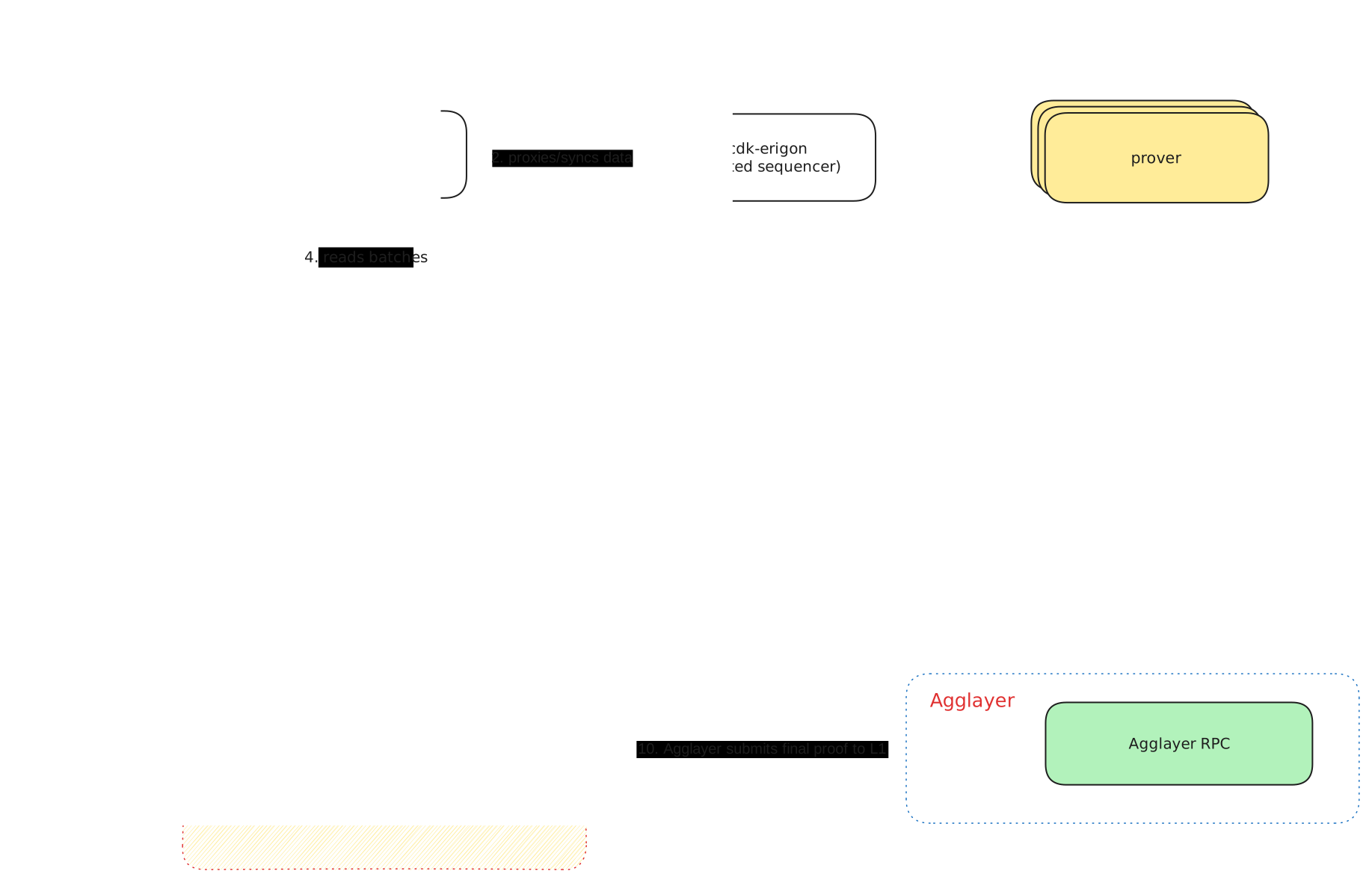
The following diagram sequentially depicts the user data flow for the CDK FEP config in validium mode using a mock prover and an Agglayer connection.
Sequential Interactions
- The user sends a transaction to the CDK Erigon RPC node.
- The CDK Erigon RPC node proxies the data to the CDK Erigon sequencer node and syncs the batch data between the sequencer and the RPC nodes.
- The sequencer sequences the transaction batches.
- The sequencer sender reads batches from the RPC node.
- In validium mode only, the sequencer sender persists transaction data into the DAC nodes.
- The sequencer sender sequences the batches into the L1 smart contracts.
- The aggregator reads batches from the sequencer data stream.
- The aggregator sends batches to the provers.
- The aggregator submits the final proof to the Agglayer.
- The Agglayer submits the final proof to the L1 smart contract domain.
Mermaid Sequence Diagram
sequenceDiagram
    participant User
    participant ErigonRPC as CDK Erigon RPC Node
    participant Sequencer as CDK Erigon Sequencer Node
    participant SeqSender as Sequencer Sender
    participant Aggregator
    participant Agglayer
    participant DACNodes as DAC Nodes
    participant Prover
    participant L1 as L1 Smart Contracts

    User->>ErigonRPC: Send transaction
    ErigonRPC->>Sequencer: Proxy and sync transaction data
    Sequencer->>Sequencer: Sequence transaction batches
    SeqSender->>ErigonRPC: Read batches
    SeqSender->>DACNodes: Persist transaction data (validium mode only)
    SeqSender->>L1: Sequence batches into L1 Smart Contracts
    Aggregator->>Prover: Send batches to Prover
    Prover->>Aggregator: Return proofs
    Aggregator->>Aggregator: Aggregate proofs
    Aggregator->>Agglayer: Submit final proof
    Agglayer->>L1: Submit final proof to L1 Smart Contract Domain
Edit on GitHub
Last updated on